When a Label Settles the Argument Before It Starts
Learn to spot loaded public labels and restate their claims neutrally, so you can assess what a policy or institution actually does before taking sides.
What does a public label like “handout,” “giveaway,” or “lifeline” actually tell you about a proposal? Usually, it reveals the speaker’s verdict before it explains the policy. To assess the argument, identify the specific feature the label points to and the standard used to judge that feature.
Public labels combine description with a verdict
An evaluative label names something while suggesting how you should feel about it. “Relief” frames a policy as help; “dependency” frames it as harmful reliance. “Reform” signals improvement, while “rollback” signals loss. A label may point toward a real feature, but it does not establish that feature by itself.
Take “wasteful.” The speaker might mean that administration costs too much, that some payments are unnecessary, or that public funds should go elsewhere. Those are different claims. Unless the speaker explains which one they mean and what standard they are applying, the label leaves the argument incomplete.
The point is not to ban forceful language or treat every position as equally sound. It is to make clear what a label asks you to accept. Once the underlying claim and standard are visible, you can decide whether the word fits.
Trace the label to its specific claim
Start with the sentence where the label appears. Identify the action, rule, institution, or group it describes. Then ask what specific feature would make the label seem accurate to the speaker. Keep that feature distinct from any motive or consequence the source has not stated.
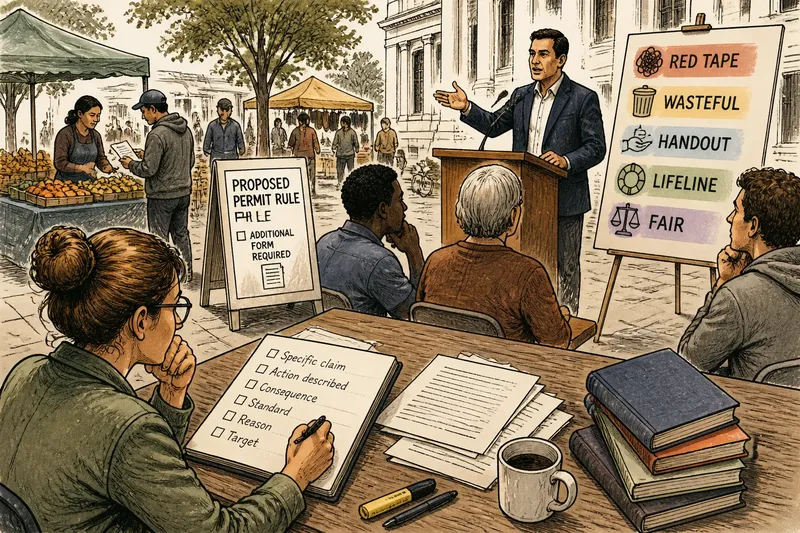
Say you read a council member’s post calling a proposed permit rule “red tape.” The post says small street vendors would need to submit an additional form before operating. A careful account is: “The proposal adds a form requirement for small street vendors seeking permission to operate.” The post may also be arguing that the form creates unnecessary work, but that is a separate claim. If it gives no reason why the requirement is unnecessary, record that gap rather than filling it in.
Some labels depend on an unstated standard. “Fair” might mean equal treatment, attention to different needs, or outcomes the speaker considers deserved. If the source does not reveal which meaning it uses, say so. Guessing at the standard can make an unclear argument sound more settled than it is.
Use this quick label check as you read
For each label, record what you can observe in the source and decide what to do next. If a point is missing, preserve the uncertainty instead of supplying an explanation on the speaker’s behalf.
- Check what the label refers to: if it names a particular rule or action, examine that feature; if its target is unclear, quote the surrounding sentence and mark the target as unspecified.
- Check whether the source describes a concrete action: if it does, restate that action plainly; if it gives only a verdict, ask what action the speaker means.
- Check whether the label asserts a consequence, such as delay or added work: if the source supports that consequence, include it as a claim; if not, do not present it as established.
- Check what standard the label relies on: if the source states one, assess the claim against that standard; if it does not, note that the judgment depends on an unstated standard.
- Check whether the source gives a reason for the label: if it does, assess that reason separately; if it does not, treat the label as an unsupported judgment rather than a full argument.
- Check whether the label targets a policy or a group of people: if it targets a policy, describe the relevant action; if it targets a group, report the wording accurately and do not turn a demeaning judgment into a neutral description of that group.
Questions about evaluating public labels?
How can I tell whether a word carries a judgment?
Ask whether the word encourages approval or disapproval before you know the supporting details. If replacing it with a plainer description changes the sentence’s emotional direction, it is likely doing evaluative work.
Should I keep a loaded word when quoting someone?
Keep the exact wording when the label itself matters, and make clear that it belongs to the speaker. Then describe the specific claim separately so readers can judge the argument without adopting the label.
What if a plain description sounds evasive?
Add the source’s concrete details, such as the action, affected group, or claimed consequence. Do not add a motive, standard, or outcome the source has not provided.
Can a label be accurate and still steer attention?
Yes. A label may fit one feature while drawing attention away from others. Name the feature that supports it, then check whether the source addresses relevant limits or tradeoffs.
Separate the wording from the disagreement
People can agree on what a policy does and still disagree about whether it is fair or useful. One person may see a form requirement as needless work; another may see it as a way to check eligibility. A clear account identifies that difference without pretending the disagreement has disappeared.
It is not worth building a private dictionary that assigns one fixed meaning to every loaded word. The same label can mean different things in different arguments. Read the sentence in front of you and follow its specific claims.
When you encounter a label again, ask what feature it names, what judgment it adds, and what standard makes that judgment seem right to the speaker. That is the useful habit: not avoiding forceful words, but knowing exactly what they ask you to accept.