A Debate Map for Your Next Ten-Minute Read
A debate map for your next ten-minute read shows what decision is at stake, who has authority, and which unresolved trade-off deserves your attention.
What decision is at stake in the article you just opened? A debate map for your next ten-minute read answers that by tracing the choice, the decision-maker, and the trade-off—not by simply restating what each side says.
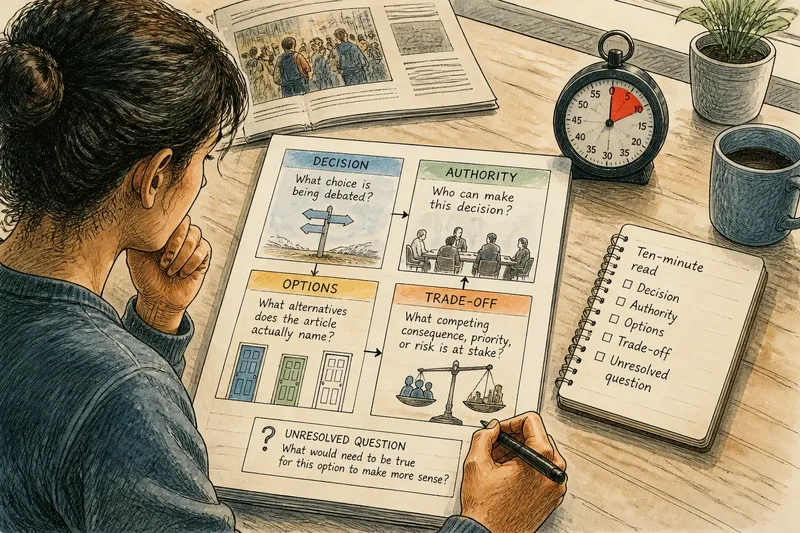
Set a timer and keep a blank page beside the article. In ten minutes, build one compact map that shows what choice is under discussion and what would need to be settled before anyone could make it.
Use one map to trace the decision
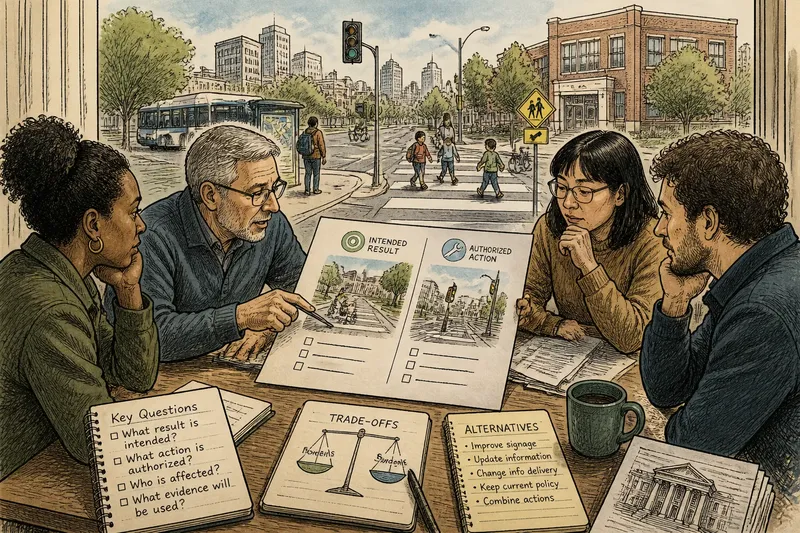
Keep the exercise to four fields: the decision, who can make it, the options named in the article, and the trade-off between them. This makes the map different from a neutral paraphrase. You are tracking how an argument connects a proposed action to its consequences and to the authority that can act.
- Decision: What specific choice is being debated?
- Authority: Which person, agency, board, or elected body can make that choice, according to the article?
- Options: What alternatives does the piece actually name?
- Trade-off: What competing consequence, priority, or risk is used to distinguish the options?
For each field, use the article’s wording as a clue, not as a verdict. If the piece leaves one blank, write “not stated” rather than filling it from memory.
Turn the topic into a decision that can be mapped
Write the decision as a question with a clear actor and action. “What should happen to schools?” is too broad. “Should the school board move the start of the school day later?” identifies both the decision and the body that would make it.
Say you are reading an invented article about a school board considering a later start. The article names students and families as affected groups but does not identify a preferred schedule or explain how transportation would change. Your map records the board as the stated decision-maker, the later start as one option, and transportation as an unresolved issue; it does not invent a second option or assume the board has settled the matter.
Trace each option to its consequence
For every option named, write the consequence its supporters expect and the concern raised by its critics. This is not a list of claims for its own sake: it shows what each choice is supposed to achieve and what it may put at risk.
Keep expected effects separate from the values used to judge them. “A later start could help students arrive ready to learn” is a predicted effect. “Student readiness should outweigh schedule convenience” is a priority. A debate can turn on either point, and the article may not provide enough material to resolve both.
Use this compact record:
- Option: What action does the article name?
- Expected result: What does a supporter say will happen?
- Concern: What consequence or risk does a critic emphasize?
- Decision test: What would the decision-maker need to know or prioritize?
Mark whether each item is described as an existing fact, a prediction, or a value judgment. That distinction helps you see whether the debate is about what is likely to happen, what matters most, or both.
Mark the trade-off that could change the choice
A useful map points to the hinge: the uncertainty or priority that could lead the decision-maker to choose differently. Ask, “What would have to be true for this option to make more sense?” Then use only details the article provides.
In the invented school-board situation, the hinge might be whether the expected benefit of a later start outweighs disruption to family schedules. If the article gives no information about either effect, write that the comparison is unresolved. The map has identified what is missing; it has not proved which choice is better.
It is not worth copying long passages, researching every background detail, or forcing an article with no clear decision into a two-sided contest. Capture a short paraphrase and the question that remains. You can investigate that question later if it matters to the decision.
What should you do when the decision is unclear?
What if the article does not name who has authority?
Write “authority not stated” and note any institution the article mentions without assuming it can act. The next question is who formally controls the decision.
What if the article gives only one option?
Record that option and mark alternatives as absent from the article. Do not invent a competing plan; note that comparing choices would require more information.
What if the disagreement concerns a prediction?
Write the prediction beside the option it supports, then note what information could confirm or challenge it. Keep that unresolved factual question separate from the values used to judge the outcome.
When should you stop the ten-minute read?
Stop when you can name the decision, the stated authority, the options the article provides, and the main trade-off or missing link. If one field remains unclear, record it as the next question rather than extending the exercise by default.
Leave yourself a map for the next read
Use the final minute to write four lines: decision, authority, options, and trade-off. Add one unresolved question, then save the article’s title or link. Keep your own preference separate from what the article says.
A debate map for your next ten-minute read is useful when it tells you what to examine next: the rule that defines authority, the details behind a predicted consequence, or the alternative the article leaves out. That focused question gives your next read a purpose.