A Policy Goal Is Not the Same as a Policy Tool
Learn to separate a policy goal from its tool, trace how a proposal is meant to work, and ask sharper questions before deciding whether to support it.
What should you ask when a proposal promises a good outcome but leaves its practical effects unclear? Separate the policy goal from the policy tool: one names the change sought, the other names the action officials propose. That distinction helps you judge the reasoning behind a proposal instead of treating its slogan as a complete argument.
A policy goal describes the result, not the action
A policy goal names a public condition officials hope to change or preserve. A tool is the specific action or arrangement intended to influence that condition. For example, a city might seek safer streets near schools and propose changing traffic signals or redesigning crossings.
Goals often draw on shared values, such as access to care, reliable transit, or fair treatment. Tools are more concrete: rules, services, grants, taxes, eligibility requirements, enforcement practices, or public information. One goal can be pursued with different tools, and a tool can affect several goals at once.
Listen for the action in a proposal, not only the value used to sell it. “Protect public health” states an aim; “require restaurants to post ingredient information” describes a tool. When a speaker presents the tool as if it were the goal, ask what result the action is supposed to produce.
Separate institutional choices from public outcomes
Two people can want the same public outcome and disagree about the action government should take. They may favor different combinations of rules, services, funding, or voluntary guidance. Treating that disagreement as opposition to the goal shuts down a useful debate about what public institutions can do and how their choices affect people.
The distinction also brings administrative questions into view. Which agency would carry out the policy? Does it have the authority, staff, and process needed? What must residents do to access a service or challenge a decision? A worthy aim does not answer those questions, and a poorly designed process can interfere with the intended result.
Make your own position precise. You might support the aim but question whether the proposed agency can deliver the tool fairly. Or you might accept the mechanism while asking officials to state the desired outcome more clearly. That gives other people a specific point to answer.
Trace what a proposal authorizes and who it affects
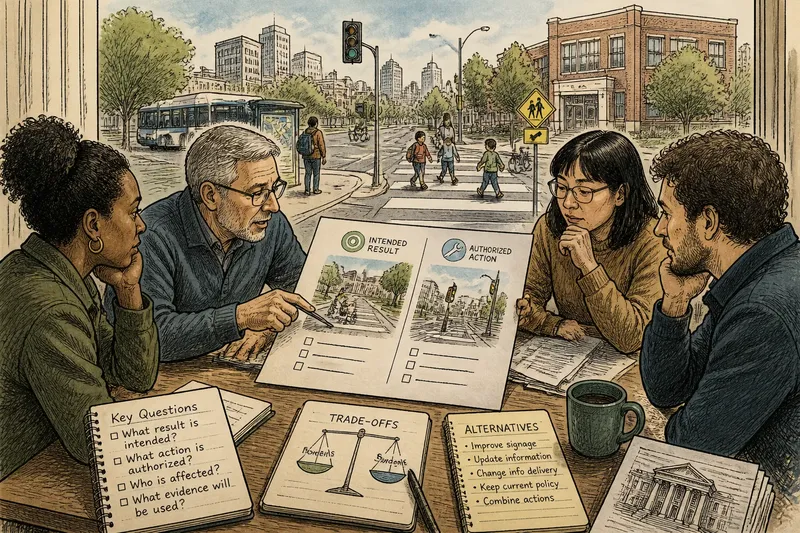
Read the operative language: the provisions that tell an agency, business, or resident what to do. Write two plain sentences: “The intended result is…” and “The proposal authorizes…” If the document names an action but not a desired result, ask what condition it is meant to change. If it names a broad value but no action, ask what officials would actually do.
Pay attention to verbs. “Expand access” or “reduce delays” signals a desired change, but the proposal should identify who or what is affected. “Fund,” “require,” “offer,” and “prohibit” usually point to an action. A sentence can contain both: “Fund evening clinics to make care easier to reach.” Funding is the tool; improved access is the intended result.
Imagine a city proposal offering grants to landlords for accessibility upgrades. The stated goal is better access to rental homes for residents with disabilities; the tool is the grant program. A reader could inspect which buildings qualify, which improvements are eligible, and how applicants are chosen. If the rules exclude the buildings most relevant to the stated aim, that is a concrete mismatch to raise—not a reason to dismiss accessibility as a public concern.
Judge whether the public rationale holds together
Look for the explanation linking the authorized action to the intended result. What is the action expected to change? Who is expected to respond, and why would that response improve the condition officials named? A proposal that skips this connection asks the public to accept its conclusion without showing its reasoning.
Then examine the boundaries. Which people, places, or circumstances are covered? Who is left out by eligibility rules or exemptions? Consider who bears new duties, who receives a service, and whether people can understand the process or seek review when a decision affects them.
Every public choice involves trade-offs, so ask whose interests the policy serves and whose needs it may neglect. A licensing rule might set quality standards while making it harder for some workers to enter a field. The relevant discussion is how the rule’s public purpose compares with that burden, and whether another plausible design could serve the purpose with fewer obstacles.
Ask what evidence officials would use to decide whether the policy is working. The answer depends on the goal: service access, delays, complaints, or the distribution of benefits may be relevant signs. A single indicator cannot replace an explanation of what changed for the people the policy concerns.
Compare realistic choices without chasing a perfect answer
Compare the proposal with the current policy and with other actions that could address the same problem. Keeping existing arrangements is also a choice: current rules and services continue to shape who gets help and how. But recognizing a problem does not make every new intervention a sensible one.
Keep the alternatives tied to the stated concern. If a transit agency says riders struggle with confusing service, possible responses might include clearer signs, updated route information, or changes to how information is shared. Each option addresses a different part of the problem. Ask which barrier officials mean to address and what the responsible institution can actually deliver.
Some policies can be revised or paired with other actions. Officials might combine a service with clearer instructions, or set a review point before expanding a program. Ask what would prompt a revision, continuation, or end. A limited rollout can also leave people without help while officials wait, so ask who bears that cost and how they will be treated during the delay.
It is not worth spending the debate searching for a flawless tool with no plausible connection to the problem. Focus on options someone could actually implement and compare the assumptions each one depends on.
Questions readers ask about policy goals and tools?
Can one proposal have several policy goals?
Yes. A proposal might seek both broader access and better service quality. Ask which goal takes priority if the tool advances one but makes the other harder to achieve.
Can officials pursue one goal with different tools?
Yes. They might use a rule, direct service, public funding, or information to address the same concern. Compare who each option reaches, what agencies must do, and what burdens it creates.
What should you ask when a proposal names a goal but no action?
Ask what the proposal authorizes and which institution is responsible for carrying it out. Without those details, the goal remains an aspiration rather than a plan the public can assess.
What should you ask when the action is clear but the goal is vague?
Ask what condition officials expect the action to change and what signs would help them decide whether to keep or revise it. A clear purpose gives residents a basis for assessing the choice.
Use precise questions to keep debate focused
Before responding to a speech, ballot measure, or proposed rule, write down the intended result and the action being proposed. Then ask what connects them. This keeps a debate about institutional choices from turning into a false claim that anyone questioning one mechanism opposes the public outcome.
At a meeting, ask: “What will this action change, and which institution is responsible for carrying it out?” If the answer describes only a value, ask what action follows. If it describes only an administrative task, ask what result officials expect. These questions give supporters and critics a shared subject to discuss.
Keep the main search question—how a policy goal differs from a policy tool—in view as you read the proposal. A public argument becomes easier to assess when it states what change is sought, what officials will do, and who will experience the effects. When one tool is rejected, ask which other plausible public action could still address the stated concern.